
Rosedene Terrace, London, E10
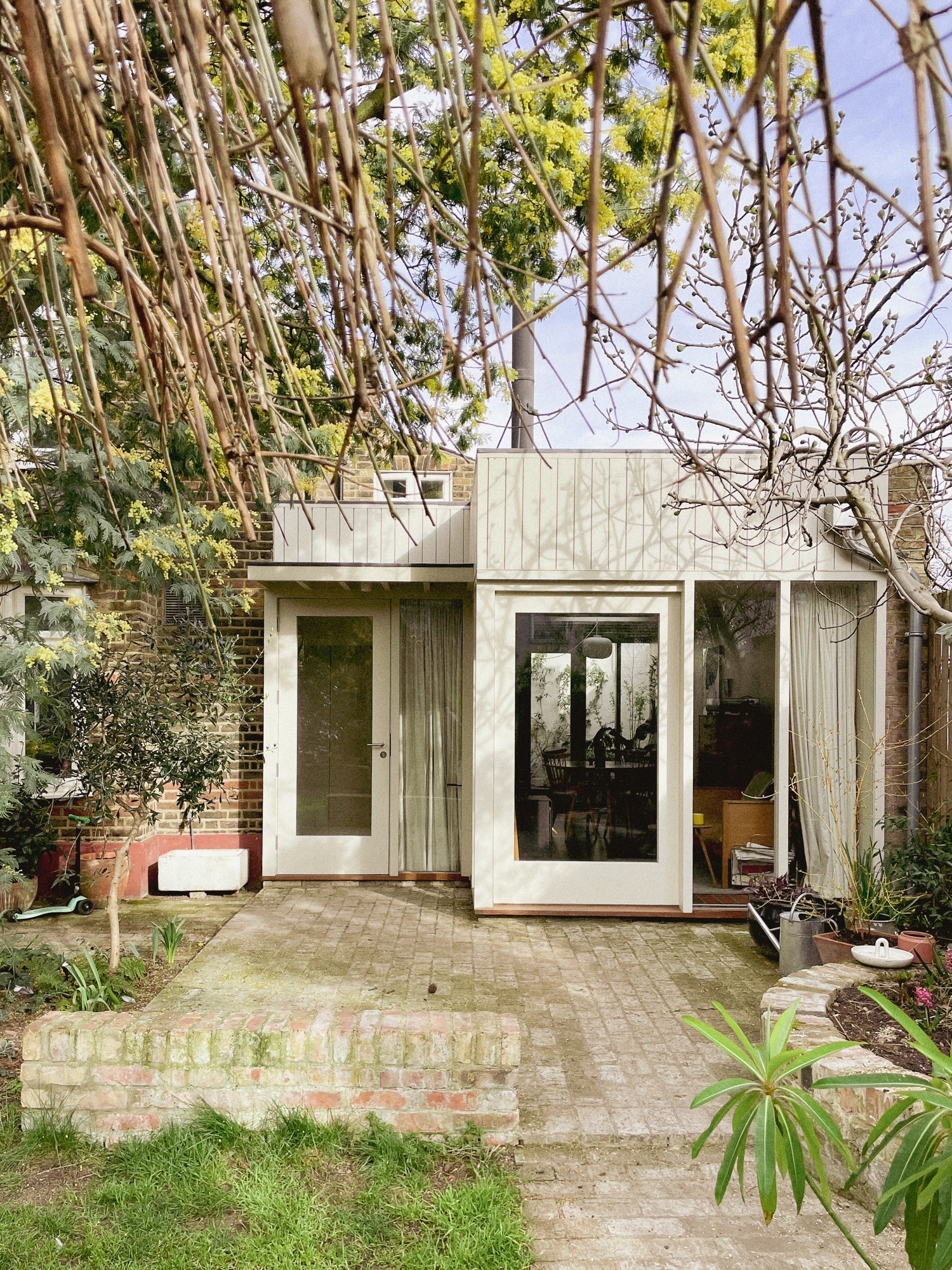
Just 3m² of internal floorspace was added to Rosedene Cottage, a small Victorian semi-detached home on Rosedene Terrace in Leyton, East London. Working with an unsympathetic flat-roofed 1970s garage addition, the project re-imagines the ground floor as a continuous, enfilade sequence of internal and external rooms, emphasised by the removal of all internal doors and sliding or opening façades, which children delight in circumnavigating.
At the junction between the original cottage and the former garage, a small square external courtyard was inserted, bringing daylight and ventilation into the plan. Lined with scented climbing plants the courtyard forms a direct visual relationship with the mature garden beyond the south-facing gable. Facing the garden here, the former garage façade is now composed of vertically proportioned timber glazing that slides and opens onto a new brick-paved patio. A small wood-burning stove marks the threshold between house and garden, with the patio paving continuing internally to form a tiled hearth and surround. A dining table is placed between courtyard and garden, animated by both façades opening during warmer months. Although scaled to their respective spaces, the two façades are treated as a single composition, unified by a tight vertical rhythm of frames and timber panelling.
The existing garage structure was retained and adapted. Its external walls were insulated and lined with painted timber panelling, while the roof joists and timber deck were revealed internally beneath a new warm flat roof. The concrete slab was insulated, raising the finished floor by 100mm to create a subtle stepped ground plane. Externally, salvaged brickwork from a neighbouring house forms low, ruin-like walls that define curved raised planters. Their geometry follows the root zones of mature ornamental trees, shaping a series of stepped garden rooms.